The neutral execution engine for clinical and genomic data. You own the infrastructure, the pipelines, and the insights they produce.
Multi-modal data ingestion across clinical, genomic, and real-world sources. Raw data is progressively harmonized: validated, deduplicated, and linked to a unified patient record. FHIR, HL7, VCF, CDISC, and custom formats.
Learn more →Variant classification, therapy matching, trial eligibility, and contraindication checking, enriched by biomedical sources like CIViC, ClinVar, ClinicalTrials.gov, and OncoKB. Reproducible execution with full lineage. Cognitive reasoning when the evidence requires it.
Learn more →Ask questions in natural language, get governed answers from your data warehouse. Cohort discovery, revenue cycle analytics, variant frequency analysis, and trial performance tracking, all from a single conversational interface with full audit trails.
Learn more →FHIR R4, HL7 v2.x, REST webhooks, streaming interfaces, and file upload. Automatic format detection and validation on arrival.
Automated patient matching across disparate source systems. Order routing across lab partners, result delivery, and care coordination. Unified canonical data model with tenant-level isolation.
AI-assisted field mapping with synonym detection. Multi-modal parser for genomics, proteomics, spatial transcriptomics, and metabolomics.
Composable clinical pipelines spanning variant classification, therapy matching, trial screening, and evidence assembly. Guaranteed output with full execution lineage.
Real-time enrichment from CIViC, ClinVar, ClinicalTrials.gov, OncoKB, gnomAD, and PharmGKB. Always returns an answer: live data when available, curated evidence as baseline.
LLM-enhanced reasoning for borderline cases with deterministic fallback guaranteed. Confidence scoring, evidence weighting, end-to-end traceability.
Ask in plain English, get governed results. Analytical capabilities spanning clinical, financial, operational, and research domains, with lineage on every answer.
Patient demographics, variant frequency, trial eligibility, screening gaps. Real-time cohort building with multi-dimensional filtering.
Billing summaries, denial rates, payer coverage analysis, test economics. From claim generation to appeal letter drafting.
VCF parsing, variant calling, AMP/ASCO/CAP classification. QC metrics, coverage analysis, concordance scoring across platforms.
Proteomics, spatial transcriptomics, metabolomics parsing and normalization. pQTL and protein-cancer risk correlation.
Organoid drug sensitivity screening, IC50 computation, therapy prediction. Correlate functional response with genomic variants.
Existing sources flow through a single governed ingestion layer. Core entities mapped, QC enforced, lineage established. No migration. No downtime.
Workflows configured, not rebuilt. Identical inputs, identical outputs, provably. Audits that took weeks now take hours.
Evidence generation, cohort discovery, clinical trial matching, and screening programs run continuously: deterministic, auditable, and at scale.
Your data stays yours. Infrastructure you control, not a black box you rent. No lock-in, no extraction, no data monetization.
21 CFR Part 11, HIPAA, and audit trails baked into every layer, not bolted on after launch. Every mutation logged.
Pipeline steps, connector results, and outputs — all signed, versioned, and reproducible. Full provenance from ingestion to delivery.
A cell therapy network had GPUs and matching algorithms, but urgent donor matching still took days due to manual scheduling.
Solution: GPU workloads were orchestrated as an execution layer, automatically prioritizing urgent cases and routing jobs across on-prem and cloud resources.
Result: Match turnaround dropped from days to minutes, GPU utilization increased significantly, and urgent cases were handled automatically with full auditability.
A biotech had strong AI-driven clinical recommendations but couldn't prove how decisions were made, blocking FDA readiness.
Solution: An immutable lineage layer was embedded beneath the AI, capturing end-to-end provenance for every input, transformation, and model version.
Result: FDA-ready traceability was achieved, audit responses dropped from weeks to hours, and every AI decision became explainable on demand.
An oncology practice was losing patients to coordination breakdowns — scheduling, authorizations, transportation, and language — not clinical care.
Solution: Care navigation was automated through an execution agent that tracked each patient's journey and resolved routine barriers in real time, escalating only complex cases to humans.
Result: Patient dropout decreased significantly, time to first treatment shortened, and the same team supported substantially more patients without added staff.
A precision oncology program was manually screening patients against trial eligibility criteria — a process that took days per patient and still missed viable matches buried across hundreds of active protocols.
Solution: Trial eligibility screening was automated against live ClinicalTrials.gov data, cross-referencing each patient's genomic profile, biomarkers, prior therapies, and staging against inclusion/exclusion criteria in real time.
Result: Screening time dropped from days to minutes per patient, match coverage expanded across the full trial landscape, and eligible patients were surfaced automatically rather than depending on manual chart review.
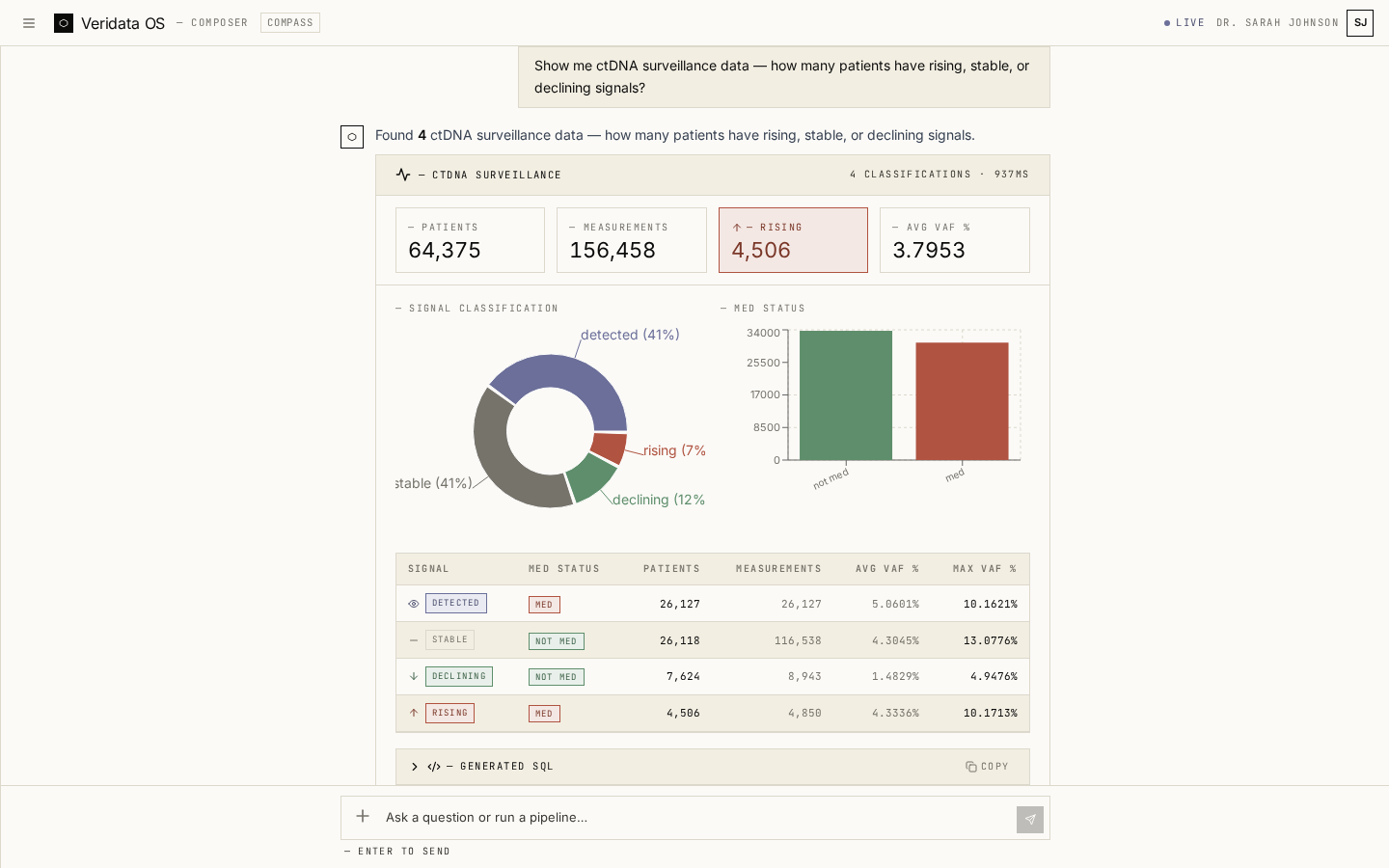
A multi-site network was generating genomic, proteomic, and ctDNA data across different platforms and timepoints — but couldn't connect the dots longitudinally. Each test lived in its own silo, making it impossible to track molecular evolution or detect emerging resistance signals.
Solution: A unified surveillance layer harmonized multi-omic data across modalities and timepoints into a single longitudinal view — linking ctDNA dynamics, variant trajectories, and proteomic shifts to surface clinically meaningful patterns automatically.
Result: Molecular signals that previously took weeks to correlate manually were surfaced in real time, enabling earlier intervention on emerging resistance and treatment response changes.
A growing diagnostics company was onboarding new health system customers faster than their engineering team could build integrations. Every new connection meant custom HL7 parsing, patient matching logic, and result routing — weeks of development per site, with no reusable pattern.
Solution: Veridata Connect provided a unified ingestion layer with format detection, schema harmonization, and automated patient matching. New system connections became configuration, not code — with end-to-end traceability and data provenance from day one.
Result: Integration timelines dropped from weeks to days per new customer, the same engineering team supported significantly more connections, and every data flow was auditable and traceable from source to destination.
Results from active engagements. Outcomes may evolve.