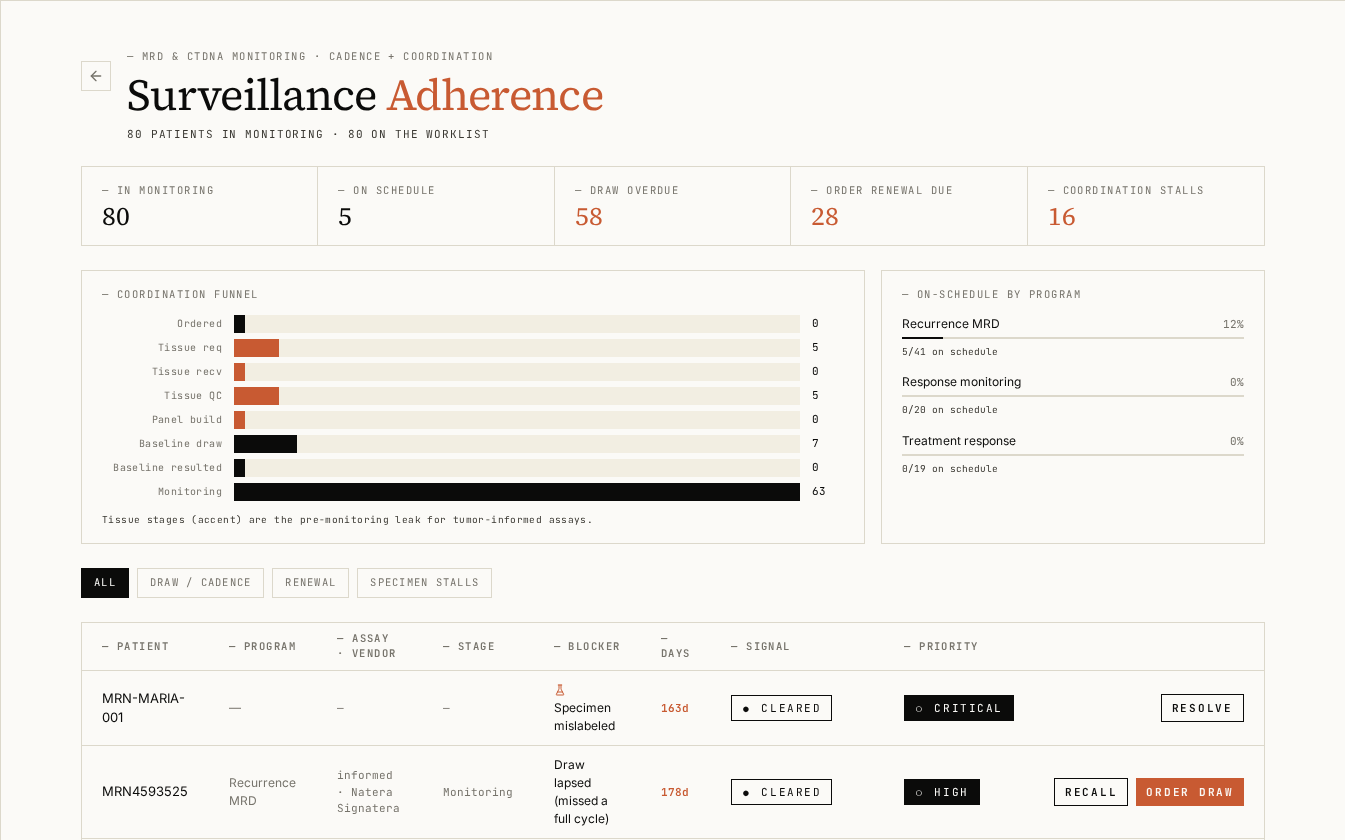
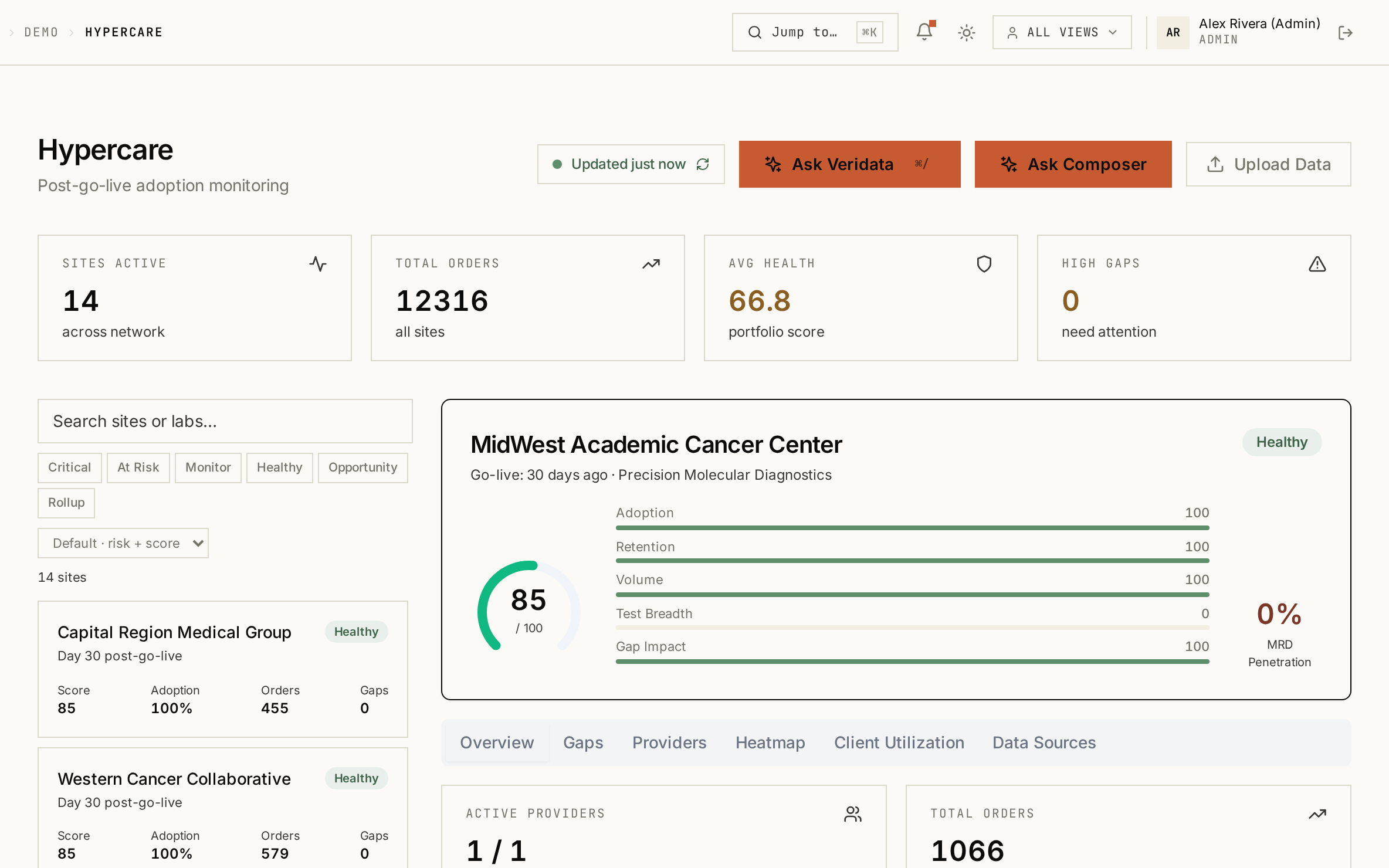
Veridata OS orchestrates the precision medicine workflow — from ingestion and classification to matching, screening, and reporting. Each capability works independently or as part of a unified pipeline.
Your clinical, genomic, and real-world data lives in dozens of systems: EHRs, LIS, LIMS, sequencing platforms, biobanks, claims databases. Connect brings them together without migration, without downtime, and without surrendering your data to a third party.
Raw data is progressively harmonized through validation, deduplication, and linking to a unified patient record. Every transformation is logged, every source is traceable, and every format is supported. For lab partners: one integration point to reach all your customers. For customers: one connection to access all your labs.
FHIR R4, HL7 v2.x, REST webhooks, streaming interfaces, file upload, and custom connectors. Automatic format detection validates data on arrival. No manual mapping for standard formats.
Automated patient matching across disparate source systems. Deterministic and probabilistic matching with configurable confidence thresholds. Order routing across lab partners, result delivery, and care coordination. Unified canonical data model with tenant-level isolation.
AI-assisted field mapping with synonym detection. Multi-modal parser handles genomics (VCF), clinical (FHIR, HL7), research (CDISC), proteomics, spatial transcriptomics, and metabolomics.
Compass is the clinical intelligence engine at the core of Veridata OS. It takes harmonized patient data and runs it through composable pipelines: variant classification, therapy matching, trial screening, contraindication checking, and evidence assembly. Complete provenance on every step.
Every pipeline produces reproducible execution by default. Identical inputs produce identical outputs, provably. For borderline cases where the evidence is ambiguous, Compass engages cognitive reasoning with confidence scoring and full audit trails. The boundary between deterministic and cognitive execution is configurable per tenant, per step.
Clinical workflows spanning variant classification, therapy matching, trial eligibility, screening programs, and revenue cycle. Each step produces a signed, versioned output. Retry any step, cascade downstream.
Real-time enrichment from CIViC, ClinVar, ClinicalTrials.gov, OncoKB, gnomAD, PharmGKB, and more. Always returns an answer: live data when available, curated evidence as baseline. Every source tagged for provenance.
LLM-enhanced reasoning activates when deterministic rules produce low-confidence results. Confidence scoring, evidence weighting, and reasoning traces. All auditable, with deterministic fallback guaranteed.
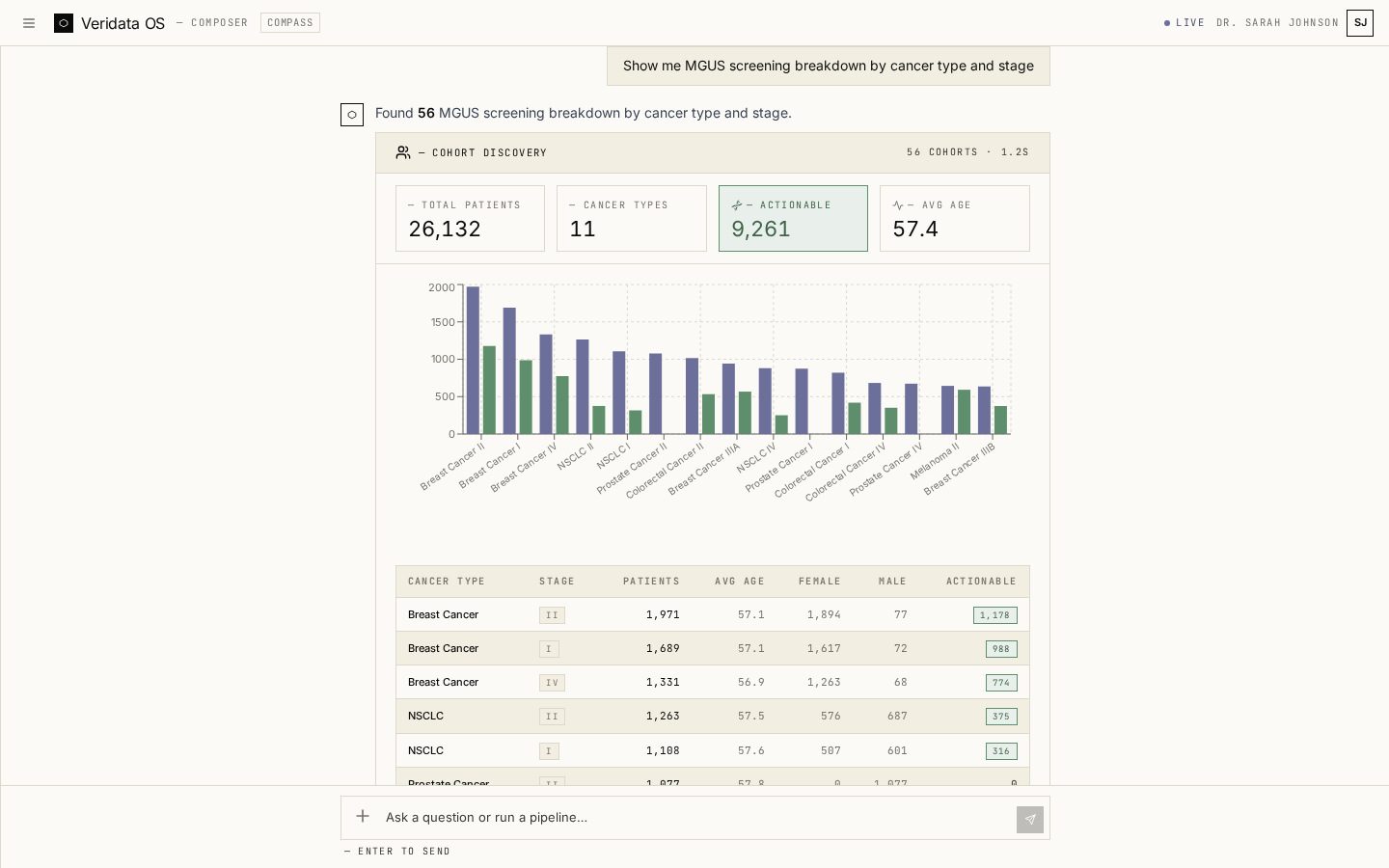
Insights turns your data warehouse into a conversational interface. Ask questions in natural language about cohort sizes, billing trends, variant frequencies, or trial performance, and get governed answers with signed execution history.
Every query is translated into validated analytical logic, executed against your data, and returned with lineage showing exactly how the answer was derived. No black-box AI. No hallucinated numbers. Your data, your warehouse, governed answers.
Ask in plain English, get structured results. Supports clinical, financial, operational, and research queries. Every answer traced back to the underlying data and logic.
Build patient cohorts with multi-dimensional filtering: demographics, variants, diagnoses, treatments, trial eligibility, screening status. Real-time population-level views from your own data.
Billing summaries, denial rates, payer coverage analysis, test economics. From claim generation to appeal letter drafting, all governed by the same audit infrastructure as clinical workflows.
Discovery extends Veridata OS into the research and translational space. Genomic, proteomic, and functional response pipelines on a single platform. Parse, annotate, and correlate across modalities with complete provenance from sample to insight.
Built for translational teams bridging the gap between bench research and clinical application. GPU-accelerated workflows with planned NVIDIA Parabricks and BioNeMo integration. Every result traceable from raw data through analysis to clinical interpretation.
VCF parsing, variant calling, AMP/ASCO/CAP classification. QC metrics, coverage analysis, concordance scoring across platforms. GPU-accelerated via NVIDIA Parabricks.
Proteomics, spatial transcriptomics, metabolomics parsing and normalization. pQTL and protein-cancer risk correlation. Cross-modal biomarker discovery.
Organoid drug sensitivity screening, IC50 computation, therapy prediction. Correlate functional response with genomic variants for precision treatment selection.